Choosing a floor

SPC or WPC: Why We Only Stock One of Them

Stone plastic composite against wood plastic composite — density, stability, sound underfoot, and why every range we stock uses an SPC core.

The short answer

SPC is a stone-plastic core: dense, rigid and dimensionally stable. WPC is a wood-plastic core: lighter, softer and warmer underfoot, but more prone to movement with heat. Every range we stock is SPC, because stability matters more than softness in an Australian house.

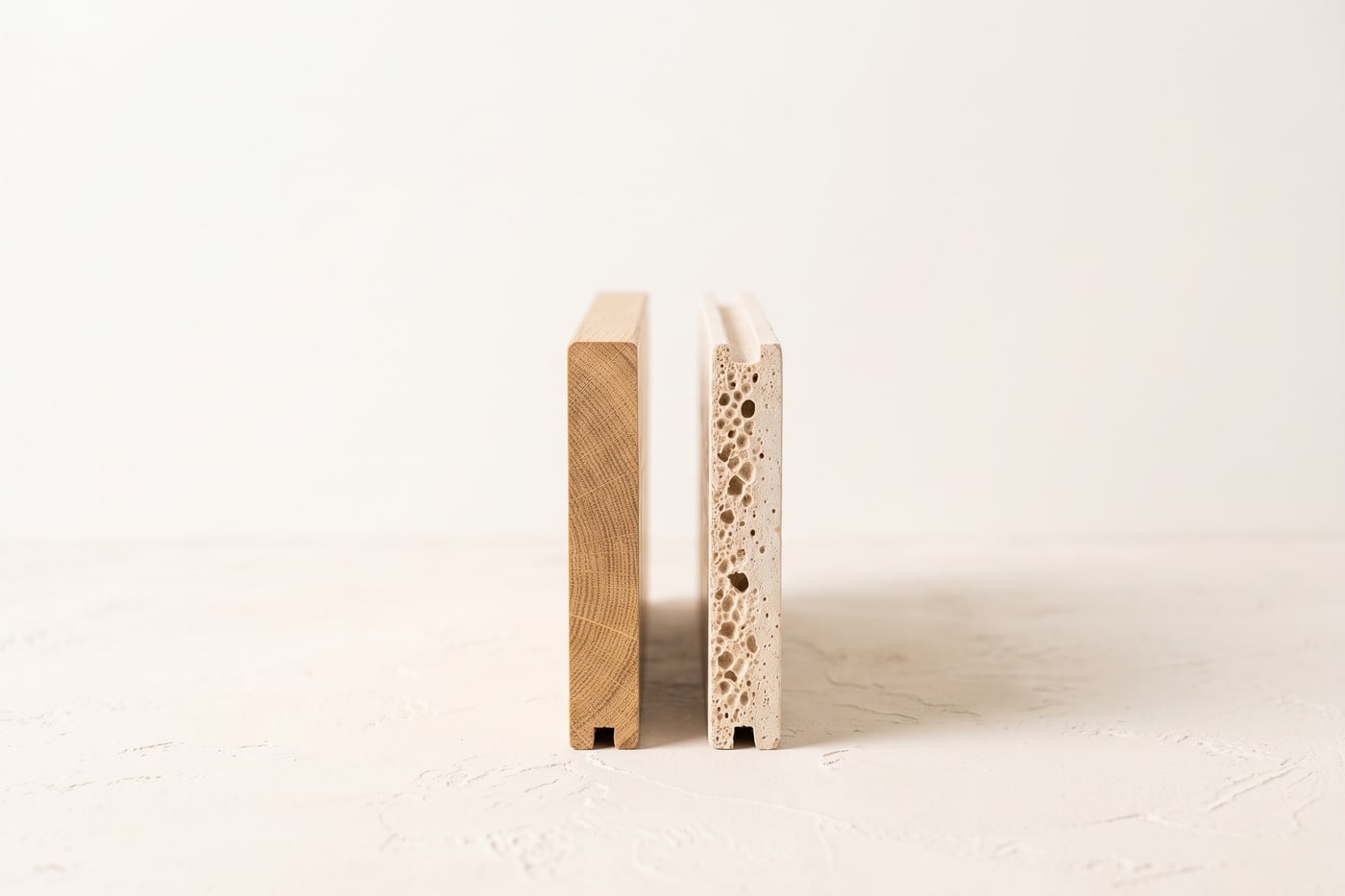
Two flooring plank offcuts standing on end side by side, cut faces toward the camera showing their different core structures

Last reviewed September 2026

What SPC is

Stone plastic composite. The core is limestone powder bound with PVC and stabilisers, extruded into a rigid board with very little air in it.

The result is dense and heavy for its thickness. It resists indentation, it barely moves with temperature, and it is completely unaffected by water.

What WPC is

Wood plastic composite. The core swaps most of the mineral filler for wood flour and a foaming agent, producing a board with air cells through it.

That makes WPC lighter, softer and noticeably warmer underfoot than SPC. It forgives a slightly uneven subfloor better, and it feels more comfortable to stand on for a long stretch.

The cost of those air cells is density, and density is what buys stability.

Density and dimensional stability

This is the decision. A dense SPC core expands and contracts very little as the room heats and cools. A foamed WPC core moves more.

In a room that gets strong afternoon sun through large glazing — which describes a great many Australian homes — that movement shows up as gaps opening at joints in summer and closing in winter, or as boards pushing against a skirting that has no room to give.

SPC is not immune to thermal movement, and it still needs proper expansion gaps at the perimeter. It simply moves less, which makes the installation more forgiving of a real house rather than an ideal one.

Density is the whole difference

Same magnification. The stone core is solid mineral and PVC; the wood-plastic core is foamed, and those air cells are what trade stability for softness.

Stone plastic composite core compared with foamed wood plastic compositeThe SPC core is drawn as dense mineral particles with no voids. The WPC core is drawn with air cells through it, which make it lighter and softer but less dimensionally stable.SPC — stone plastic compositeLimestone and PVC. No air.Stable, hard, heavyBarely moves in direct sun. Resists point loads.WPC — wood plastic compositeWood flour, PVC and a foaming agent.Softer, warmer, lighterMoves more with heat. Dents more easily.Every range we stock uses a stone core, because stability is what decides how a floor looks in five years.

Behaviour under heat and direct sun

Direct sunlight through glass concentrates heat on a floor far more than ambient room temperature does. A north-facing living room with floor-to-ceiling glazing can run substantially hotter along that strip than the rest of the room.

That differential is where a less stable core gets into trouble, because one part of a connected floating floor is expanding while the rest is not.

This is a large part of why our four ranges are SPC or HDF rather than WPC. Underfloor heating adds the same kind of stress from below, and the two core materials behave differently under it: our manufacturer rates the SPC hybrids to a 36°C floor surface temperature and the HDF-cored TITAN laminate to 28°C.

Indentation and point loads

A dense core resists point loads better. Fridge feet, a heavy bookcase, a piano leg or a stiletto concentrate a lot of weight onto a very small area.

SPC holds up well under that. A foamed core is more likely to take a permanent dent, because the air cells compress and do not fully recover.

This matters most in kitchens with heavy appliances and in rooms with substantial furniture that never moves.

Sound underfoot

WPC's air cells absorb sound, so a bare WPC board is quieter than a bare SPC board. That is a genuine advantage of the construction.

In practice it matters less than it sounds, because neither is installed bare. Our hybrids ship with IXPE acoustic underlay bonded to the plank — 1.5mm on SILVA 7mm, 2mm on AXEN 9mm — which is doing the acoustic work.

EVSPC goes further, adding a 2mm luxury vinyl top layer over the SPC core. That is what gives it the warmer, quieter feel people associate with WPC, without giving up the stability of a stone core.

Click systems: 2G against 5G

The core is only half the engineering. How the boards lock together decides how the floor behaves over time.

A 2G system engages by angling the long edge in, then dropping and tapping the short edge home. It works, it is well proven, and it usually needs a tapping block and mallet on the short joint.

A 5G system uses a sprung insert on the short edge that engages as the board drops. You angle in the long side and the short side clicks itself — no tapping, and a joint that pulls itself tight and stays tight.

EVSPC uses a patented 5G click system. The practical difference is joint strength and speed: fewer opportunities to damage an edge with a mallet, and a tighter short joint under foot traffic.

2G and 5G, at the joint

Both lock the long edge by angling the board in. They differ at the short edge, which is where installation time and joint strength are actually decided.

Two click-lock joint profiles compared in cross-sectionA 2G joint is closed by tapping the short edge horizontally into its neighbour. A 5G joint carries a sprung insert that engages automatically as the board is lowered.2G — tap the short edge homeAngle the long side, drop, then tap with a blocktapped sideways5G — it clicks itselfAngle the long side, lower the board, donedropped inWorks, well proven. A mis-hit bruises the profile,and a bruised lock never seals properly again.The sprung insert pulls the joint tight and holds itthere. No block, no mallet, less chance of damage.EVSPC uses a patented 5G system.

Does SPC need underlay?

Not on our ranges — IXPE acoustic underlay is already bonded to the underside of every hybrid plank we stock.

More importantly, you should not add another layer beneath it unless that has been specifically approved for the product and application. Additional cushioning under a rigid floating floor lets the boards flex, and flex is what works a click joint loose.

If a specification calls for additional acoustic performance, the answer is the right product and the right test report, not a second underlay improvised on site.

What we actually stock, and why

SILVA 7mm and AXEN 9mm are SPC hybrids with attached IXPE. TITAN 12mm is laminate on an HDF core. EVSPC 12mm is an SPC core with a 2mm vinyl top layer and a 5G click system.

None of them are WPC, and that is deliberate. In a climate with hot summers, big glazing and a lot of concrete slab construction, dimensional stability is the property that decides whether a floor still looks right in five years.

If comfort underfoot is your priority, EVSPC is the answer within the SPC family — the thick vinyl top layer gives you the warmth without the movement.

Common questions

Is SPC better than WPC?

For dimensional stability, indentation resistance and behaviour in direct sun, yes. WPC is softer and warmer underfoot. We stock SPC because stability is the property that determines how a floor ages in an Australian house.

What does SPC stand for?

Stone plastic composite — limestone powder bound with PVC and stabilisers, extruded into a rigid, dense, waterproof core.

What is the difference between a 2G and a 5G click system?

2G engages the long edge by angling, then the short edge by tapping down. 5G uses a sprung insert so the short edge clicks itself as the board drops — no tapping, a tighter joint, and less risk of damaging an edge during installation.

Does SPC flooring need underlay?

Not on our ranges — IXPE acoustic underlay is factory-bonded to every plank. Do not add another layer unless specifically approved; extra cushioning under a rigid floating floor damages the click joint.

Is acoustic underlay worth it?

It is doing real work — dampening the hollow sound of a floating floor and reducing impact sound to the room below. On our hybrids you get it as part of the plank rather than as an extra decision.

Is EVSPC an SPC or a WPC?

SPC. Its core is stone plastic composite. The warmth and quiet people associate with WPC come from its 2mm luxury vinyl top layer, not from a foamed core.

Ready to Request a Quote?

Browse the catalogue, shortlist your preferred range, and send us your project details for direct-to-market pricing.