Choosing a floor

The AC Rating, and Where the Ladder Actually Stops

What the AC wear rating measures, where AC3, AC4 and AC5 belong, and why our TITAN 12mm laminate is rated AC4 rather than chasing a higher number.

The short answer

AC is an abrasion class from AC1 to AC6 that rates how well a laminate surface resists wear. AC3 covers all domestic use, AC4 adds moderate commercial, AC5 is for heavy commercial. Our TITAN 12mm laminate is AC4, which is more than any home needs.

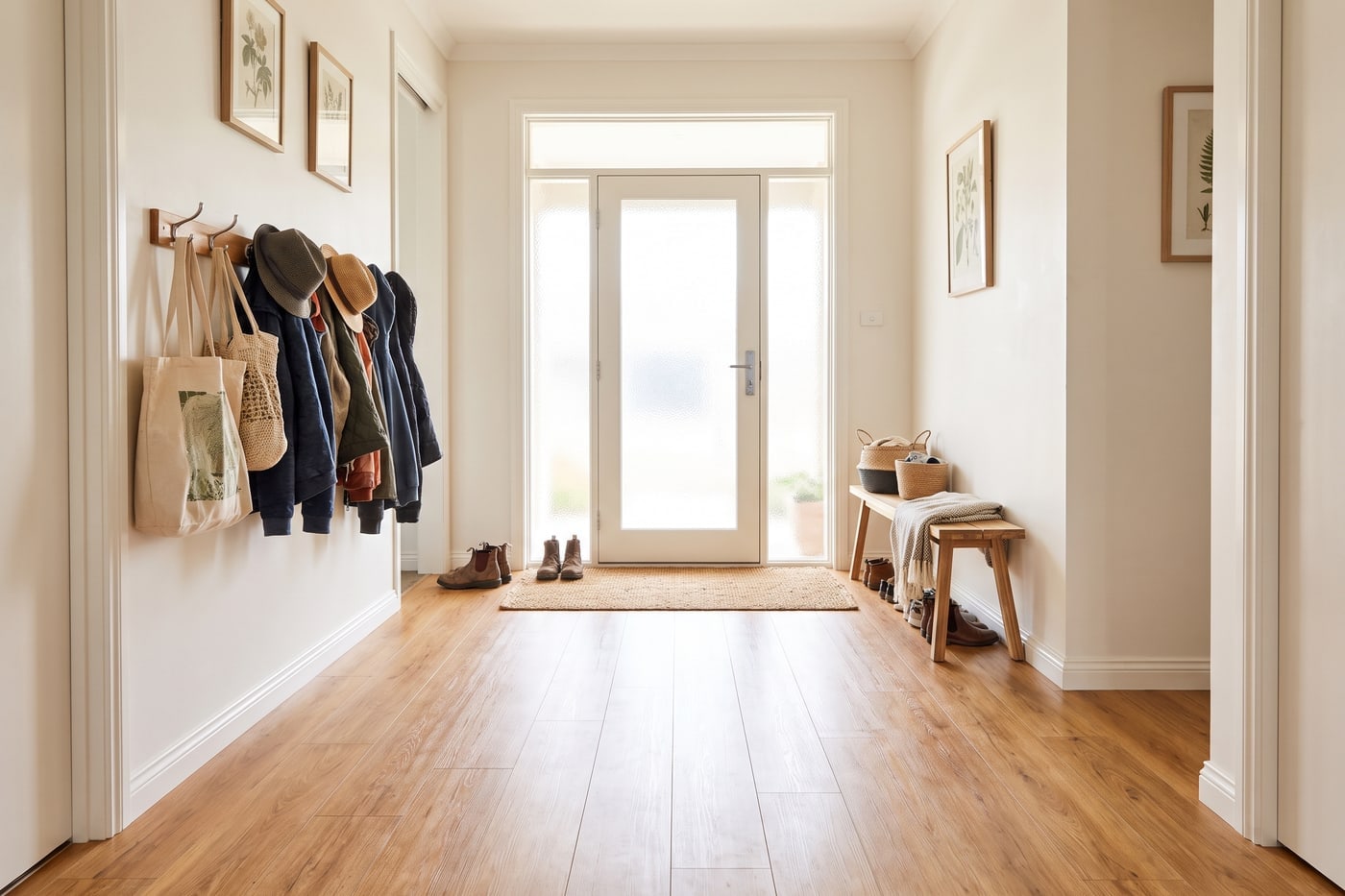
A family entry hall with timber-look flooring, a woven doormat and daylight through a glazed front door

Last reviewed September 2026

What the AC rating actually measures

AC stands for abrasion class. It comes from a standardised test where an abrasive wheel is run against the laminate surface until the decor layer wears through, and the class is set by how many cycles that takes.

It is a surface-wear measurement and nothing else. It is a genuinely useful number, but it is narrower than most retail descriptions imply.

What it does not measure

AC says nothing about water resistance. An AC5 laminate in a laundry will still swell if water reaches the core.

It says nothing about impact resistance. Abrasion and a dropped saucepan are different failure modes.

It says nothing about how the floor sounds, how it feels underfoot, or how well the joints hold together.

So a higher AC number is not a higher-quality floor in general. It is a floor with a more abrasion-resistant surface, which matters enormously in a shop entrance and barely at all in a bedroom.

The scale, rung by rung

Six classes, each with a real-world setting attached.

  1. AC1 — light domestic. Bedrooms, and not much else. Effectively obsolete in the Australian market.
  2. AC2 — general domestic. Living and dining rooms in a quiet household. Also increasingly rare.
  3. AC3 — heavy domestic and light commercial. Any room in a busy family home, plus a small office. This is the practical floor of the market.
  4. AC4 — heavy domestic and moderate commercial. Everything AC3 covers, plus offices, boutiques and cafés. This is where TITAN sits.
  5. AC5 — heavy commercial. Department stores, public buildings, sustained foot traffic all day.
  6. AC6 — very heavy commercial. Rare, expensive, and specified for genuinely punishing environments.
The AC scale, and where it stops mattering

AC rates surface abrasion and nothing else. It says nothing about water, impact or how the floor sounds.

The AC abrasion class scale from AC1 to AC6AC3 already covers heavy domestic use. TITAN 12mm laminate is rated AC4, which adds moderate commercial. AC5 and AC6 are specified for heavy and very heavy commercial settings.AC1Light domesticBedrooms. Effectively obsolete here.AC2General domesticQuiet living and dining.AC3Heavy domesticAny room in a busy family home.enough for a homeAC4Moderate commercialOffices, boutiques, cafés.TITANAC5Heavy commercialDepartment stores, public buildings.AC6Very heavy commercialRare, and punishing environments.Hybrid is not on this scale at all. Its durability is measured as wear-layer thicknessin millimetres, which does not convert to an AC number.

AC3: enough for almost every home

AC3 is rated for heavy domestic use, which in the test's terms means a busy household with children, pets and traffic through a hallway all day.

For a domestic floor that is genuinely sufficient. Most laminate sold into Australian homes is AC3, and most of it performs perfectly well for its whole life.

AC4: what TITAN is, and why

TITAN 12mm laminate is rated AC4 — heavy domestic and moderate commercial.

In a home that means the surface is specified well beyond what the room will ever ask of it, which is the margin you want in an entry, a hallway or a kitchen where grit gets walked in.

In a light commercial setting it means the floor is genuinely rated for the job rather than being a domestic product pressed into service. For a café, a consulting room, a small office or a boutique, AC4 is the right specification.

It also pairs with a 12mm HDF core, which is where the impact resistance comes from. The AC rating and the core thickness are doing two different jobs, and a good floor needs both.

AC5: when a home does not need it

AC5 is built for department stores and public buildings — spaces with thousands of people crossing them daily.

Specifying AC5 for a house is paying for abrasion resistance that the room will never consume. The money is better spent on core thickness, on a better decor and embossing, or on the subfloor preparation that actually determines whether the floor lasts.

The exception is a genuinely commercial fitout with sustained public traffic, where it earns its cost.

Wear-layer thickness is not the same thing

This is the confusion worth owning, because it trips up almost everyone comparing a laminate against a hybrid.

Laminate is rated on the AC scale. Hybrid and vinyl are described by wear-layer thickness in millimetres — a 0.3mm, 0.5mm or 0.7mm clear film over the decor.

They are two different measurements of two different constructions, and there is no conversion between them. "AC4" and "0.5mm wear layer" are not two points on one ladder.

So when you are comparing our TITAN laminate against our SILVA or AXEN hybrid, the AC rating is not the axis to compare on. Compare what the floor has to survive in the room you are putting it in — and on water, hybrid wins regardless of any number on either spec sheet.

How to use the rating when you are choosing

Decide the room first, then read the rating as a floor rather than a target. If it is a home, AC3 is sufficient and AC4 is comfortable margin. If it is a shop or an office, start at AC4.

Then stop optimising the AC number and look at the things it does not cover: core thickness, whether the room gets wet, board size, and how the floor will be installed. Those decide more about the outcome than one more rung on the abrasion ladder.

Common questions

What does AC4 mean on flooring?

AC4 is an abrasion class rating the laminate surface for heavy domestic and moderate commercial use — homes, offices, boutiques and cafés. Our TITAN 12mm laminate is AC4.

Is AC4 better than AC3?

It is more abrasion resistant. Whether that is better depends on the room: AC3 already covers heavy domestic use, so in a home AC4 is margin rather than necessity. In a light commercial space, AC4 is the right starting point.

Do I need AC5 in my house?

Almost certainly not. AC5 is specified for department stores and public buildings. In a home the extra abrasion resistance goes unused, and the money is better spent on core thickness or subfloor preparation.

What AC rating is hybrid flooring?

None — hybrid is not rated on the AC scale. Its durability is described by wear-layer thickness in millimetres. The two scales are not comparable and there is no conversion between them.

Does a higher AC rating mean a more waterproof floor?

No. AC measures surface abrasion only. It says nothing about water resistance — an AC5 laminate will still swell if water reaches its fibreboard core.

Is wear layer thickness the same as AC rating?

No. Wear-layer thickness describes hybrid and vinyl; AC describes laminate. They measure different constructions with different tests, and a thicker wear layer does not translate to an AC number.

Ready to Request a Quote?

Browse the catalogue, shortlist your preferred range, and send us your project details for direct-to-market pricing.