Choosing a floor

7mm, 9mm or 12mm — What the Extra Millimetres Buy

Thickness changes sound, feel and how much subfloor imperfection a floor forgives. What actually separates 7mm, 9mm and 12mm in practice.

The short answer

Hybrid flooring is usually 7mm to 9mm including its attached underlay, with 12mm products adding either a fibreboard core or a thick vinyl top layer. Thicker buys rigidity over an uneven subfloor, better acoustics and a more solid feel underfoot — not a more durable surface, which is set by the wear layer.

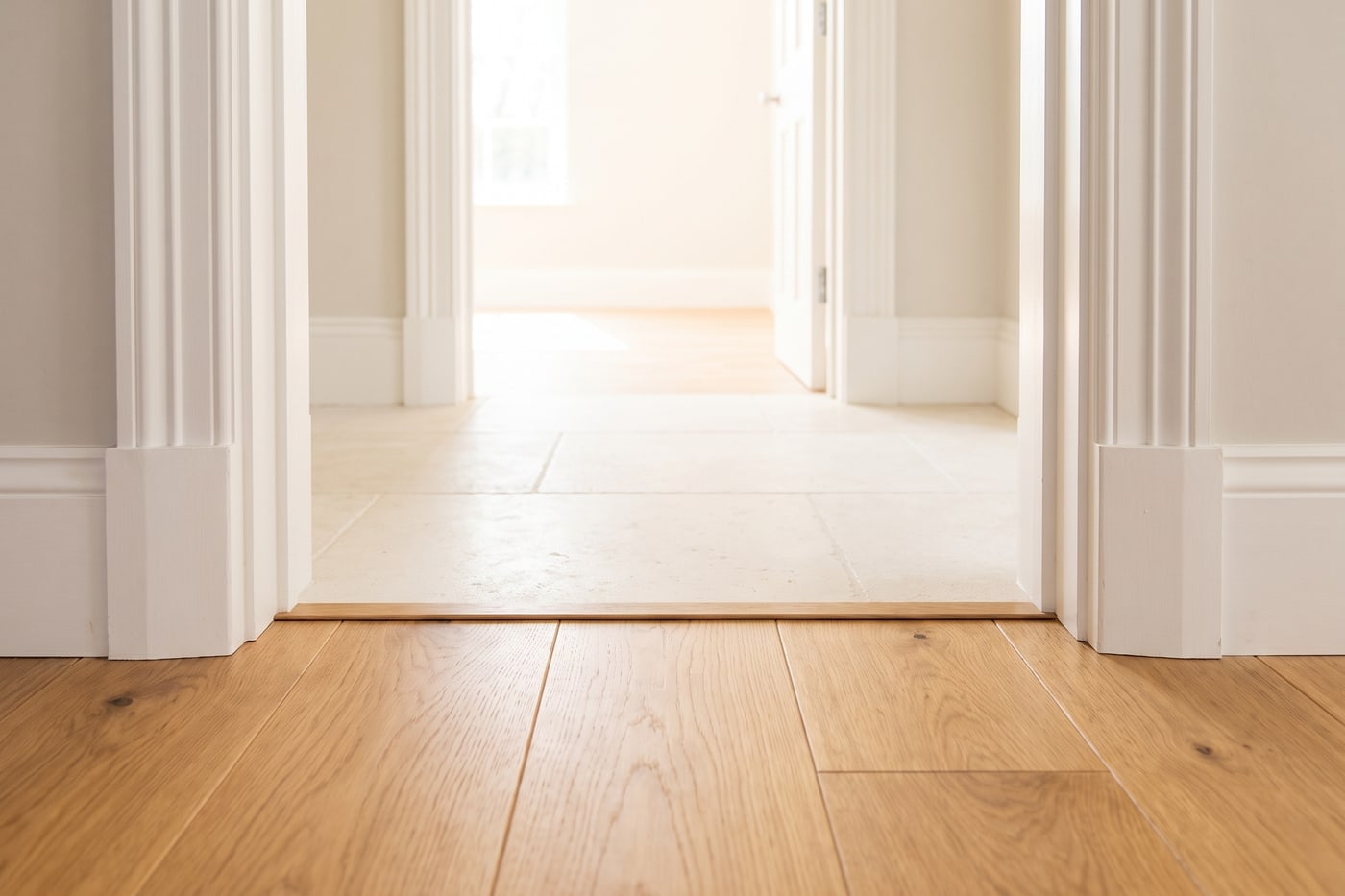
A doorway threshold where timber-look plank flooring meets tile, joined by a slim colour-matched transition strip

Last reviewed September 2026

What thickness actually changes

Three things, and one thing it does not.

  1. Rigidity — a thicker core spans minor subfloor imperfection instead of following it. This is the biggest practical difference.
  2. Acoustics — more mass and thicker attached underlay mean less sound transmitted to the room below and less hollow noise underfoot.
  3. Feel — a thicker board reads as more solid and slightly warmer under bare feet.
  4. What it does not change is surface durability. That is set by the wear layer, which is measured separately and can be identical on a 7mm and a 9mm plank.
The four ranges, to scale

Each drawn at the same scale, sitting on the same subfloor line, so the thicknesses are genuinely comparable. Colour shows what each layer is made of, not what the floor looks like.

Four flooring ranges compared in cross-section, drawn to scaleSILVA 7mm is a 5.5mm stone-composite core over 1.5mm acoustic foam. AXEN 9mm is a 7mm core over 2mm foam. TITAN 12mm is a solid high-density fibreboard core. EVSPC 12mm is a 2mm vinyl top layer over an 8.5mm stone core and 1.5mm foam.SubfloorSPCSILVA7mm hybrid7mmIXPESPCAXEN9mm hybrid9mmHDFTITAN12mm laminate12mmSPCVinylEVSPC12mm composite12mmThickness changes rigidity, acoustics and feel underfoot.It does not change surface durability — that is set by the wear layer.

SILVA 7mm — the trade standard

5.5mm SPC core plus 1.5mm attached IXPE acoustic underlay.

This is the thickness most hybrid sold in Australia lands at, and there is a reason it is the trade favourite: over a sound, flat subfloor it does everything a domestic floor needs to do, and the height works comfortably under existing doors without trimming.

It is the right choice for a slab in good condition, for a renovation where door heights are tight, and wherever budget is doing real work in the decision.

AXEN 9mm — where the extra 2mm goes

7mm SPC core plus 2mm acoustic IXPE underlay.

The core is 1.5mm thicker than SILVA and the underlay is 0.5mm thicker, and both differences point the same way: a more rigid floor that is quieter to walk on and more forgiving of a subfloor that is not perfectly flat.

It is the one to choose over an older timber subfloor, in an apartment where impact sound to the neighbour below matters, and in a kitchen or living area where you spend hours standing.

It is genuinely noticeable underfoot next to a 7mm. If you can handle both before deciding, do.

TITAN 12mm — different material, different reasoning

12mm laminate on a high-density fibreboard core, rated AC4.

This is not a thicker hybrid — it is a different construction. The HDF core gives excellent impact and dent resistance and a substantial, warm feel that hybrid does not match.

The trade-off is water. HDF swells permanently once water reaches it, which is why TITAN belongs in living areas and bedrooms rather than kitchens and laundries. It also needs a separate underlay, which on concrete must include a moisture barrier.

EVSPC 12mm — the outlier

12mm composite, 1830 × 229 × 12mm per plank, 3 planks per carton covering 1.257m².

EVSPC puts a 2mm luxury vinyl top layer over a waterproof SPC core with attached acoustic underlay, and locks with a patented 5G click system rather than a conventional joint.

That thick vinyl top layer is what makes it different. It is warmer and quieter underfoot than any standard hybrid — closer to the feel people associate with a wood-plastic core — while keeping the dimensional stability of a stone core.

The 5G system also matters practically: the short edge clicks itself as the board drops rather than needing a tapping block, which means a tighter joint and fewer chances to damage an edge during installation.

What thickness forgives, and what it does not

A thicker, more rigid board bridges small undulations rather than conforming to them. Over a slab with gentle waves, 9mm will feel more solid than 7mm.

What no thickness fixes is a subfloor outside tolerance. Every one of these floors needs the substrate flat to the tolerance in its installation documentation. A thicker plank laid over a dip still flexes, and flexing is what eventually works a click joint loose and creates hollow spots.

Buying a thicker floor to avoid preparing the subfloor is the most expensive mistake available in this category, because you pay for the thicker floor and then pay again to lift it.

Sound and impact

Two different things get confused here. Impact sound is what the neighbour below hears when you walk. Ambient sound is the hollow click you hear in the room itself.

Attached IXPE underlay addresses both, and more of it addresses them better — which is the case for AXEN's 2mm over SILVA's 1.5mm in an apartment.

If a body corporate has a specific acoustic requirement, ask us for the test reports for the range you are considering so they can be checked against the building's actual specification rather than assumed.

Doors, thresholds and height

Total floor height is the plank plus anything under it, and it has to work with what is already in the room.

Internal doors are the usual constraint. Going from carpet to 7mm hybrid usually gains clearance; going to 12mm may mean trimming doors, which is a service quoted separately.

Thresholds to existing tile or timber need a transition strip, and the bigger the height difference the more obvious it is. If you are flooring only part of a house, matching heights across the join is worth planning before ordering.

Kitchen kicks, sliding door tracks and bath panels are the ones people forget until the floor is down.

Underfloor heating

Compatibility and maximum floor surface temperature are product-specific, and they matter more than usual with a floating floor because heat drives dimensional movement.

Both hybrids run to the same limit, so thickness is not the deciding factor here — SILVA 7mm and AXEN 9mm are both rated to 36°C at the floor surface. The difference that matters is core material rather than thickness: TITAN's HDF core is held to 28°C, which is the lowest limit in our range.

The limit is a surface temperature, not a thermostat setting. Set the system to hold the floor below it rather than assuming a comfortable room temperature keeps the floor in range.

Maximum floor surface temperature by collection
CollectionMaximum floor surface temperature
SILVA 7mm Hybrid36°C
AXEN 9mm Hybrid36°C
TITAN 12mm Laminate28°C
Measured at the floor surface, not at the thermostat. Confirmed by our manufacturer, September 2026. EVSPC is supplied by an external supplier and is not covered by these figures.

Which to choose

Sound flat slab, tight door heights, budget matters — SILVA 7mm.

Older or slightly uneven subfloor, apartment, or a room you stand in for hours — AXEN 9mm.

Dry rooms where impact resistance and a substantial feel matter most, and water is not a risk — TITAN 12mm laminate.

Warmth and quiet underfoot without giving up a waterproof core, or a project where installation speed and joint strength matter — EVSPC 12mm.

If you are still undecided, order free samples of two and put them on the actual floor in the actual room. Thickness is the specification least well judged from a photograph.

Common questions

How thick is hybrid flooring?

Typically 7mm to 9mm including the attached acoustic underlay. We stock SILVA at 7mm (5.5mm core plus 1.5mm IXPE) and AXEN at 9mm (7mm core plus 2mm IXPE), plus two 12mm products of different construction.

Is thicker hybrid flooring better?

Thicker means more rigid, quieter and more solid underfoot. It does not mean more durable — surface durability comes from the wear layer, which can be identical across thicknesses.

What is the difference between 7mm and 9mm hybrid?

9mm has 1.5mm more core and 0.5mm more acoustic underlay. In practice: more rigidity over an uneven subfloor, better impact sound performance, and a more solid feel.

Will thicker flooring hide an uneven subfloor?

It bridges minor undulation, but it does not fix a subfloor outside tolerance. Every one of these floors needs the substrate flat to the tolerance in its installation documentation, regardless of thickness.

What size are EVSPC planks?

1830 × 229 × 12mm, with 3 planks per carton covering 1.257m². It uses a 2mm luxury vinyl top layer over a waterproof SPC core and a patented 5G click system.

Will thicker flooring stop my doors closing?

It can. Going from carpet to 7mm usually gains clearance, but 12mm may require door trimming. Check thresholds, kitchen kicks and sliding door tracks before ordering.

Ready to Request a Quote?

Browse the catalogue, shortlist your preferred range, and send us your project details for direct-to-market pricing.